
Lack of swimming pools in Brussels: one public pool for every 68,000 residents, compared with one for every 22,000 in Flanders
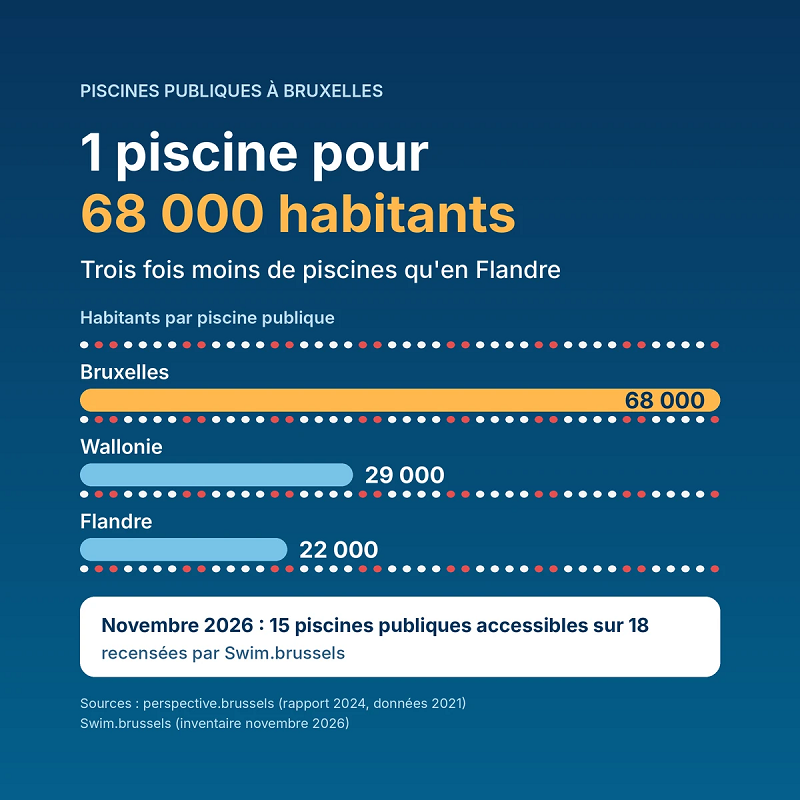
With one public swimming pool for roughly every 68,000 residents, compared with one for every 22,000 in Flanders, Brussels faces a structural shortage of aquatic facilities. Schools, families and low-income households are the first to feel it.
A shortfall confirmed by official figures
On 26 October 2026, the Brussels news outlet BRUZZ reported on the shortage of public swimming pools in the capital and its consequences for learning to swim. The figures it quotes come from a study carried out by the consultancy CityTools for the Sport Unit of perspective.brussels, published in January 2024 and based on 2021 data.
According to this inventory, the Brussels-Capital Region has:
- 61 pools in total, public and private, of which only 31 are open to all Brussels residents;
- 18 public facilities, run by the municipalities, the French Community Commission (COCOF), the VUB university and the federal state, 17 of which are open to the general public;
- one public pool for roughly every 68,000 residents, compared with one for every 29,000 in Wallonia and one for every 22,000 in Flanders.
Relative to its population, Brussels therefore has about three times fewer public swimming pools than Flanders.
The facilities are also ageing: according to the same study, 85% of Brussels swimming pools were built before 1976.
In November 2026: only 15 public pools actually open
These official figures describe the pools as they stood in 2021. Swim.brussels keeps its own inventory, updated continuously with the municipalities and pool managers. This is therefore not an update of the same census, but two snapshots taken at different times.
In November 2026, of the 18 public pools listed by Swim.brussels, only 15 are actually open to the public: the Victor Boin pool in Saint-Gilles and the Poséidon pool in Woluwe-Saint-Lambert are closed for works, and the Royal Military Academy pool is not open to the general public. In practice, the available offer is even smaller than the study’s figures suggest.
Unevenly distributed pools
On top of the lack of facilities, there is a problem of distribution. Not every municipality has a public pool, and some residents have to travel to a neighbouring municipality to swim, which means travel time, transport costs and, often, a higher non-resident rate. The gap between resident and non-resident prices varies from one pool to another: our comparison of public swimming pool prices in Brussels lets you check them at a glance.
The perspective.brussels study identifies the biggest gaps in Anderlecht, Forest, lower Molenbeek-Saint-Jean and the North district. Anderlecht, with around 120,000 residents, has only one public pool, at the CERIA campus.
By contrast, the east of the Region is home to more than half of the private pools. According to the study, these partly make up for the lack of public pools, but they deepen socio-spatial inequalities in access to swimming: where public provision is lacking, being able to swim depends more on what people can afford.
Swimming lessons on the front line
The shortage of pools has a direct impact on schools. They share a limited number of time slots, which shrinks further whenever a pool closes for renovation.
BRUZZ illustrates this with the Koninklijk Atheneum Etterbeek: at this school, only third-year sports science students still have swimming lessons, at the VUB pool.
Yet knowing how to swim goes well beyond sport. It is a safety skill, useful in a pool as well as in a lake or at sea, and it also means understanding the dangers of water: currents, fatigue, differences in temperature. For many children in Brussels, school remains the only place to learn it.
Necessary renovations that reduce the offer
Many Brussels pools are several decades old. Renovating them is essential to modernise facilities, cut energy consumption and secure their future. But these works sometimes lead to long closures, which shift the pressure onto other pools.
- Victor Boin pool (Saint-Gilles): closed since 1 July 2023 for renovation and safety works. First announced for early 2026, then for completion of works in May 2026, the reopening is now expected in 2027.
- Poséidon pool (Woluwe-Saint-Lambert): closed since 1 January 2026 for a major energy renovation initially planned to last six months. In autumn 2026 it is still closed and its reopening date has not been confirmed. During the works, Woluwe-Saint-Lambert residents can use the resident rate at Sportcity.
- Sportcity pool (Woluwe-Saint-Pierre): closed for renovation from 3 May to 29 August 2027, with reopening planned for 30 August 2027. These dates have been confirmed by the pool’s management. The agreement between the two municipalities then works the other way round: Woluwe-Saint-Pierre residents get the resident rate at Poséidon. But if Poséidon has not reopened by then, both Woluwe pools could be closed at the same time.
The agreement between the two Woluwe municipalities shows that cooperation between municipalities can limit the impact of closures. It is also a reminder that during works, knowing which pool is open, on what conditions and at what price becomes essential information.
What are the solutions?
In its study, perspective.brussels makes several recommendations for making better use of existing facilities:
- set up a coordination forum for pool managers;
- harmonise prices between residents and non-residents of the municipality;
- extend opening hours, especially in the evening;
- open some school pools to the public;
- pool certain tasks between municipalities (recruitment, lifeguards, public procurement);
- give users an interface showing occupancy and bookings.
For new facilities, the study mentions a specialised public operator, public-private partnerships and smaller, more energy-efficient pools.
A concrete project is moving forward at the Abattoir site in Anderlecht. Around 4,000 m² are to be developed on the roof of the Manufakture building, with a 25-metre indoor pool, a learner pool and an outdoor pool. A private partner will design, build, finance, maintain and operate the complex, with time slots reserved for schools and clubs and prices in line with other public pools. According to the timetable presented in September 2026, the contract is due to be awarded in 2028 and opening is planned for 2030, provided the procedure and works go as planned. The project is eagerly awaited, but it will not close the current gap on its own.
Swim.brussels: making existing pools more visible
When pools are scarce, unevenly distributed and sometimes closed for months, simply knowing where to swim becomes a challenge. That is the role of Swim.brussels, an independent information website dedicated to swimming pools in the Brussels-Capital Region.
The site brings together the practical information needed to choose a pool: opening hours, prices (including resident and non-resident rates), facilities, access conditions and activities. It pays particular attention to the needs of different groups, such as families with young children or women looking for women-only sessions.
Through its detailed pool pages, price comparisons and information regularly checked with municipalities and pool managers, Swim.brussels helps make swimming in Brussels easier to understand and more accessible. The site makes it easy to keep track of closures, reopenings and access conditions at each pool.
Building new pools remains essential. In the meantime, clear and up-to-date information about existing pools helps everyone in Brussels find where to swim, and on what terms.
Sources
- perspective.brussels, Piscines : état des lieux des piscines en Région de Bruxelles-Capitale et recommandations liées à l’amélioration de l’accès aux piscines publiques (swimming pools in the Brussels-Capital Region: current situation and recommendations), January 2024 (CityTools study, 2021 data), in French: full report (PDF)
- perspective.brussels, Les piscines en Région bruxelloise : état des lieux et pistes pour rencontrer les besoins des Bruxellois, ABOUT.brussels no. 2, April 2020, in French: note (PDF)
- BRUZZ, Brussel heeft drie keer minder zwembaden dan Vlaanderen (Brussels has three times fewer pools than Flanders), 26 October 2026, in Dutch: article
- VRT NWS, Bruxelles franchit une nouvelle étape pour l’aménagement d’une piscine en plein air à Anderlecht, 17 July 2026, in French: article
- Swim.brussels, Sportcity pool closed from 3 May to 29 August 2027, 30 October 2026 (dates confirmed by Sportcity management)
- Dynamic Tamtam, rate agreement between Woluwe-Saint-Lambert and Woluwe-Saint-Pierre, December 2025, in French: article